Health Freedom Index: 2026 Edition
A 50-State Freedom Index of Health and Healthcare
Download the Full Report [PDF]
Download the Data [XLSX]
Download the Errata [PDF]
"Health Freedom Index: 2026 Edition" Center for Modern Health & Knee Regulatory Research Center. August 2026.
The Health Freedom Index is a comparative assessment of the legal, regulatory, and policy environments governing healthcare across the United States. The index compiles state-level data on the degree of choice and freedom available to patients, healthcare professionals, insurers, and entrepreneurs. Individual measures are used to produce scores for each state, as well as an overall ranking. In addition to providing state rankings, the project aims to promote transparency and informed discussion about the role of freedom, voluntary exchange, and institutional design in American healthcare. It does not measure health or health outcomes.
ABOUT THE 2026 INDEX
This report expands the scope of analysis to 54 policy variables across five broad domains: 1) Professional Freedom, 2) Institutional Freedom, 3) Patient Freedom, 4) Payment Freedom, and 5) Delivery Freedom. Together, these categories provide a comparative picture of how much freedom patients, healthcare professionals, insurers, entrepreneurs, and institutions have to make voluntary healthcare decisions within each state.
Each variable in the index is scored on a freedom-oriented scale from 1 to 5, with higher scores indicating greater freedom (i.e., a less restrictive policy environment). The variables are then grouped into five category scores and combined into an overall Health Freedom score for each state and the District of Columbia. The index is unweighted, meaning each variable receives equal treatment. This choice avoids imposing assumptions about which policies matter most and allows readers to use the underlying data to conduct their own analyses with their own weighting choices.
THE STATE RANKINGS
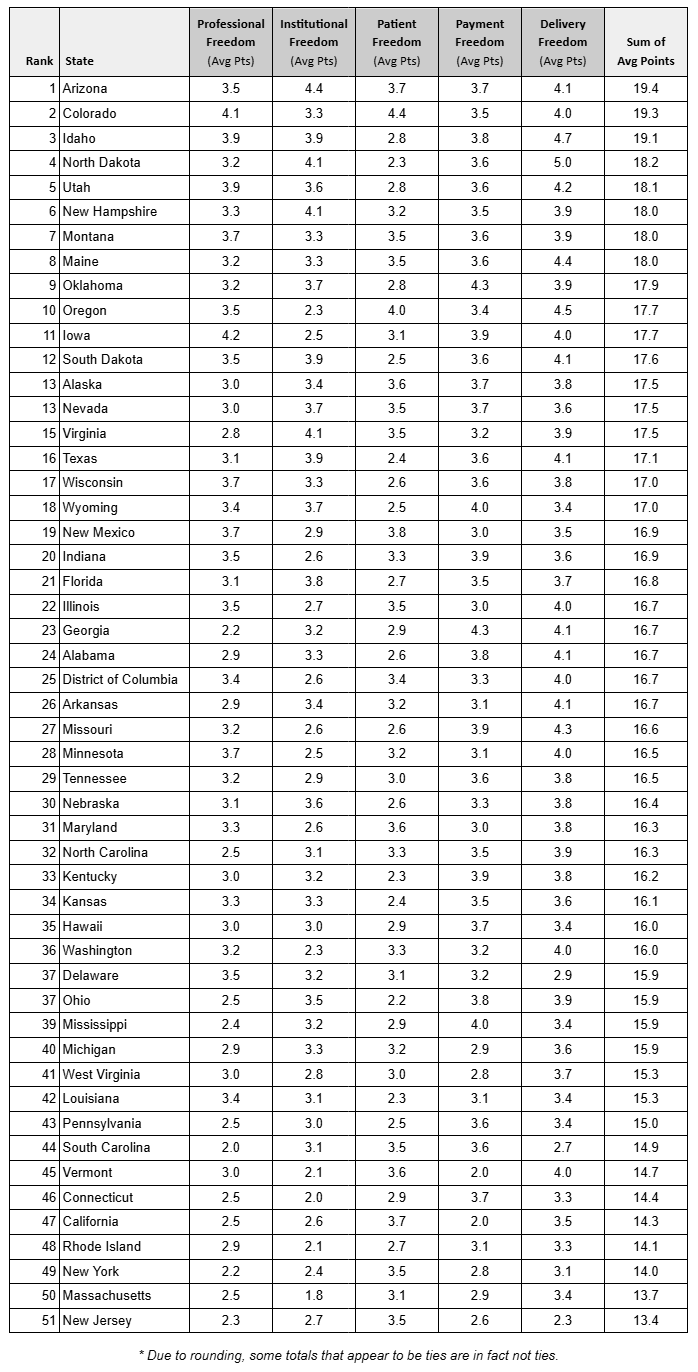
Below are the 2026 Health Freedom Index state rankings, along with the actual scores for each state in each category, and each state's overal point total. A perfect score in each category would be a 5.0 points. A perfect score for the entire index (i.e., sum of all five categories) would be 25 points.
THE OVERALL MAP
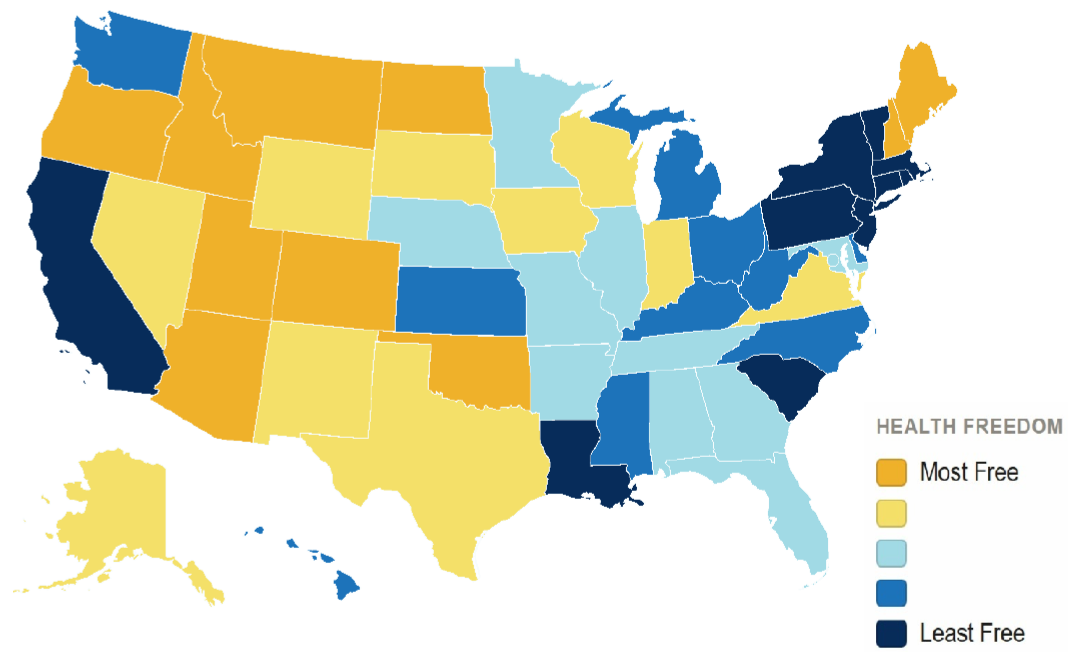
The map below provides a visual snapshot of health freedom across the 50 states. Lighter shades indicate states with greater freedom, while darker shades indicate more restrictive policies. Together, the rankings and map show where states are removing barriers to competition, innovation, and patient choice. It also shows where researchers, advocates, and policymakers could improve health freedom.
This report is designed to be a useful resource and a conversation starter for those seeking to expand choice, competition, innovation, and voluntary exchange in American healthcare. By making state policy environments more transparent and comparable, we aim to support a more informed discussion about how policymakers can improve health freedom in their states.
FULL LIST OF VARIABLES
The 54 variables scored in this index are:
- State allows medical license portability
- State requires less postgraduate training for U.S. medical graduates
- State has fewer continuing medical education requirements
- State grants nurse practitioners broad scope of practice
- State has fewer optician licensing requirements
- State grants psychologists prescriptive authority
- State allows midwives broad scope of practice
- State grants pharmacists broad scope of practice
- State grants dental hygienists broad scope of practice
- State has less restrictive prescriptive authority for certified registered nurse anesthetists
- State limits liability for charity caregivers
- State recognizes off-label free speech in medicine
- State allows foreign-trained physicians to apply for license without repeating residency training
- State has fewer certificate-of-need restrictions
- State allows freestanding birth centers
- State allows freestanding emergency departments
- State puts fewer restrictions on compounding pharmacies
- State has fewer provider taxes
- State doesn't restrict pharmaceutical company access to physicians
- State allows ownership freedom for medical practices
- State does not require advance notice for private equity activity
- State does not impose rate-setting or price controls on hospitals
- State allows mutual aid socieites to operate freely
- State allows pharmacists to dispense hormonal birth control without physician prescription
- State has lower excise taxes on e-cigarettes
- State allows lay distribution of naloxone
- State allows patients to use psychedelic substances for medical use
- State allows patients to seek medical aid in dying
- State allows minors to obtain/consent to contraception
- State allows abortion
- State does not interfere with reproductive technology
- State allows patients Right-to-Try investigational treatments
- State allows possession of drug checking equipment
- State mandates fewer health insurance benefits
- State does not constrict age rating further than federal law
- State has fewer health savings account (HSA) taxes
- State does not mandate that individuals buy health insurance
- State does not restrict short-term renewable health plans
- State does not mandate insurers have a Gold Card program
- State allows out-of-state insurers to issue health insurance in the state
- State allows underwriting (vs. guaranteed issue) starting at a lower employee threshold
- State does not regulate Pharmacy Benefit Managers (PBMs)
- State allows health savings-like accounts within Medicaid
- State allows Medicaid patients to engage in direct pay for covered services
- State allows broad Medicaid reimbursement by provider type
- State has less restrictive telepresenter requirements
- State has less restrictive telepharmacy location laws
- State has more flexible opioid prescription rules
- State allows online prescribing
- State allows online eye exams
- State offers protection for Good Samaritans
- State does not treat concierge medicine / DPC practices as insurance
- State allows drug dispensing by concierge medicine / DPC practices
- State allows wholesale lab pricing by concierge medicine / DPC practices
The identical report and data can be downloaded from the Knee Regulatory Research Center's website. Both institutions plan to publish additional articles and analyses using the data from the Health Freedom Index, so stay tuned for more.